Thursday, August 16, 2007

Why the world hates America?


I read about Postglobal during one of my aimless surfing sojourns and came across this and I was hooked on to it. The first thing that stuck me while reading the blog was, "How I wish, I could also do the series!" (I remember having felt something similar before) It's an amazing assignment which gives a chance to go to different countries and meet different kinds of people from all over the world. I personally feel it's a huge kick for any journalist. Sigh....I wish I'm able to do something similar in future. However, I thought I will do an email interview with Amar C Bakshi, the chief contributor of the project and well, here it is....
How did you become involved with the project? What has been your personal interest in it?
I proposed it to Fareed Zakaria, David Ignatius and Hal Straus. They were all very supportive. I've been fascinated by views of America ever since seeing strong political anti-American rhetoric in Zimbabwe. It is also a crucial issue facing Americans, one worth exploring and putting a human face on.

How many countries have you visited till now for this project?
So far I've been to England and India. I'm in Jammu&Kashmir now, going to Pakistan next week. Then I'm taking a break for a few weeks before pushing off to East Asia or the Middle East.

Starting afresh in a new country with an assignment can be quite a task. Can you tell me a little more about how did you go about your work in various countries? Who all helped you?
I've received great help from MJ Akbar, who put me in touch with Asian Age correspondents around the country. Similarly India Express reporters in Srinagar and Calicut were very helpful. It varies greatly -- between contacts from the Post, friends, other journalists and luck I manage to get by.

You have met a lot of people and written about hem on your blog too. Can you talk about any interesting experience which you haven't mentioned in the blog? (Something that would be irrelevant for the site, but interesting nevertheless)
Well, I've made a lot of friends along the way. The girls from the TV in the American Language piece opened up Manchester nightlife for me, which was a blast, and I got a real deep look into Blackburn's tabacco hookah scene before the smoking ban went into effect.

What are the apsirations of the youth you met in various cities and countries?
Big question, but basically to earn money, have fun, and improve the lot of their family or community in some way. Aspirations of youth are vital. I always ask about it, especially because often the U.S. is a part of those aspirations for more education or money, or to resist. Anyway, not sure what else to say here. Maybe you can be more specific?

Your parents are from India. As opposed to the initial views you had about India, what are the different things that you experienced about India especially in this specific assignment?
Well, America was always the sole land of opportunity for my parents. I'm seeing now more and more how India itself has become the land of opportunity for many of the brightest students. Seeing this energetic, hopeful part of India is wonderful.

Did you come to Bangalore? (Bangalore has a huge section of population working in call centres serving clients from USA) I believe you went to Mumbai and interacted with the call centre junta there. What were your observations? How was it visiting South India?
I loved South India. I loved the way people laugh there. I visited call centers primarily in Chennai, and didn't end up going to Bangalore for a variety of logistical reasons, and because a lot of American journalists seem to go there, I figured I'd look at Hyderabad or Chennai. I spent time in Kerala too driving up and down.
I found call centers very interesting because of the aspirations of the young who work there -- for money, success, material things, and a chance. Often America represents a meritocratic ideal, which is interesting. Also, it's fascinating for Americans to see who it is calling them. I think it might be alienating for call center employees to call hostile, distant Americans, and it might be aggravating for Americans to get distant phone calls, but by putting the two communities in touch online and showing a face to both sides, it creates understand, the goal of this project. I was proud of the call center piece and hope it gets more Americans aware of just who calls them.

You talk about Muslims in madrassas being close minded. But are you aware of instances of modernisation of Madarssas wherein Maths, English are being introduced? (There are some madrassas like that in Bangalore)
I never talked about Muslims in madrassas being closed minded. In fact, my post was about how modern Muslim madrasas in Malegaon can be. I've taken readers/viewers into madrasas in Malegaon to show them how progressive they can be, how education-oriented they can be
My other post talked about how Muslim teachers avoided teaching politics, but curious students wanted to know more. And in that case the teachers used history and theology to say that there is no need to enter politics because all great powers fall. It's a peaceful but tricky balance. *** Please fix your line above where you say I say Muslims in madrassas are closeminded. This is a misunderstanding on your part. Thank you!***

For a patriot (you mention in a post about how you hung American flag prominently at the entrance of your house after 9/11) was it unnerving to hear people's opinions regarding their hatred for America? Was this the first time you were personally coming across such views?
It was unnerving. See this. But it wasn't the first time. Doing research in Zimbabwe I can across really vehement criticisms of the U.S. as a neo-colonial force by a lot of government ministers who got political mileage, like Mugabe, off of such rhetoric.

Books like Inheritance of Loss, The Kite Runner have portrayed that despite the faults, USA is still the place to realise one's dreams. Do you think it is a dominant perception while interacting with the youth in India? How was it interacting with a upper middle class urban Muslim youth of India?
Yes, I think it is true. America still represents great hope. In Srinagar, for example, I am finding the same. Now there are certainly chinks in America's gleaming armor, but it still as an ideal holds weight. Upper middle clas urban Muslim youth that I met were incredibly bright and worldly. Like most Indians, they criticized recent American foreign policy and hoped that it would genuinely support human rights and democracy, and like most Indians they felt great love for the idea of America, though wariness of its international actions over time, and especially lately.

Racial profiling of people from South Asia is a common phenomenon in USA that was started after the 9/11 attacks. Do you think that plays a important role in how South Asians view USA post 9/11?
Yes, I think racial profiling in America has a real bad impact on perceptions abroad, especially because these cases make big news here, while they might not make quite as a big a headline in the U.S. I hear, though I do not know, that this is especially true in Pakistan.

Why have you put on a beard before going to Pakistan? This is interesting because 'beard' + 'South Asian' looks are a stereotype for a Muslim terrorist. Do you think people In Pakistan will warm up to you because of your appearance? Does looking similar to the majority help in any way?
I might shave the beard. It was a bit of a joke, but maybe not an appropriate one. I really haven't had much time the past few months, I've been traveling, been busy, and have only carried the bare necessities around (which doesnt include a razor and cream) so I just haven't gotten around to it. I might well shave it off this weekend when I catch my breath. But as far as looking local, my appearance has helped. I don't stick out quite so much when I travel, which helps me get my camera in different places without raising quite as many eyebrows.

You have interviewed non resident Indians as a part of your project too. How do they view India?
A good place to invest, a place of rich history/culture, a place that could benefit from some of the looser social mores that America has -- particularly vis a vis gender and class.

What do you think is this project going to achieve? How has the reaction been of American readers to your articles?
It's added depth to news items and given people a glimpse at human lives around the world touched by America. I think it might help people have a sense of the impact of their electoral decisions, and the degree to which America is involved globally. There are many ways Americans can help shape the world for the better from smart buying to aid to votes. So far the reaction has been great. People are saying they didn't have a human face on a lot of big issues: like a student at a madrasa or a call center employee. This project puts it out there, encourages readers to interact with interviewees, and tries to make people see people around the world so headlines become more than just a sound-byte, but a bit of understanding - empathy and hope - for others around the world.

Saturday, July 21, 2007

A day when I was almost attacked...

It was just any other day (or so I thought) till I got a call informing me about a raid by the labour department. The raid was on a brick kiln unit wherein the owner was practising bonded labour. It's an amazing story. It took a man from Orissa to point out the instance of bonded labour in Bangalore while the Bangalore city cops had no clue about the going ons in their own backyard. Bijaya kumar Babu, a social worker from Orissa tipped off the labour commission in the city about the practice of bonded labour at SRB Chamber Bricks, a brick kiln unit in a village in Anekal, 30 kilometres from Bangalore. One of the members took a chance escaped leaving behind his wife in the brick kiln unit. Once back home, he contacted Das who works with the tribal and Dalit community in Orissa.

He then got in touch with South India Cell for Human Rights Education and Monitoring (SICHREM) and informed them about the situation here. The people trapped in the brick kiln unit were mainly Dalits and tribals who had come all the way to Bangalore in search of employment. He also told me that National Rural Employment Guarantee Act is in shambles in the state which is prompting lot of people from Orissa to come all the way to Bangalore. One of the main reasons that Bangalore lures people is the construction boom here. There are apartments being constructed left, right and centre here. Now that the city's become greater Bangalore, the constructions will only increase. (Trivia: Greater Mumbai is 434 sq. km whereas Greater Bangalore is 721 km. Greater Bangalore is almost double than that of Mumbai.) Another reason why they are in demand is because migrant workers don't demand as much money as the local employees.

I took my camera and went to the spot along with officials from labour department, revenue department and a bunch of human rights activists from SICHREM and Association for Promoting Social Action (APSA). I had never been to an actual raid before. So it was quite exciting :D

Most of the people were from various villages of Bolangir district in Orissa. Their condition out there was very bad. We heard some horror stories. No one was allowed to go home with their family. Mamta, a worker said, "I was beaten up black and blue when my husband tried to ask for higher wages. I was not allowed to breast feed my kids for three weeks. They beat up my husband too. I desperately want to go home. I asked them for a leave. But they did not grant me one." There were cases of child labour too. N B Ramchandra, labour officer-Bangalore said, "The children ought to be subjected to medical examination by a doctor to determine their exact age. After that, can we give the exact statistics of the number of children involved in child labour." The workers alleged that they were paid Rs 400-500 per week per family.

When the team went to the spot, they were very happy. They were expecting us since Bijaya had gone to the place in disguise couple of days before informing them about the raid. Overjoyed, they immediately started packing their bags. However, some associates of Nanjundaiah began physically abusing the labourers and the activists despite the presence of labour officials and the police personnel. They also prevented the government officials to take the labourers along with them. Bijaya was slapped real hard by the goons. We couldn't do anything because there were just two police officials with us who did nothing. When I spoke to the Anekal police, they told me that the labour department officials had only asked for two people and that they provided the people likewise. They also said it is difficult to handle such last minute requests. The human rights activists told me that during such kind of raids, the police is always informed in the last minute because word usually spreads fast and the owners of such kind of places always manage to escape.

The labour department had hired a truck to ferry the people. However, as soon as the labourers boarded the truck the goons forcibly tried to pull them out of the truck. Mind you, the goons who were being violent were only 3-4 of them. In comparison the workers were about 50 of them. But they were so scared. Mentally they had surrendered. To see them so meek somehow disturbed me. They could have easily over powered the men since they were so few in number. The owner had still not reached the spot and his men were simply creating ruckus. It was such a helpless feeling. Despite crying for help, we couldn't do anything. I couldn't spot the police officials at all.

The goons also thrashed the ETV cameraman. His camera was broken as they demanded the cassette from him. However, he was smart and in the nick of time managed to replace the original cassette with an empty one. Looking at the situation, the media persons decided to quickly leave the place. I had to leave early since I had a deadline to meet. One of my friends from Hindu who had come in a car offered me a lift. As soon as we sat in the car we saw that the owner had come. We again rushed out in order to get his version. I spoke to him and clicked his picture. Within few minutes went back to the car and were all set to leave. Suddenly, 5-6 goons rounded up the car and the driver had to stop it. They began banging the car furiously. Me and my friend looked at each other. We were really scared now. We had not exactly locked the doors. They opened it and demanded the camera. "Who has the camera? Delete our boss's photo. Tell us where the camera is?" they shouted. I was really scared now. I was the one with the camera. In the whole melee, they were confused about who exactly took the camera. I was confused. I did not want to part away with my camera and pictures. Well, why should I? But at the same time, I wondered, they only want me to delete the picture na. I should simply delete it and go away from the wretched place. In the midst of all the nonsense, I was wondering what exactly to do.

My friend did not have the camera with her. She screamed at them saying that she doesn't have it. We were seated inside. But they started searching the car. They even tried to open my friend's bag. Meanwhile, I started crying for help. I also told them that I don't have the camera. The Hindu photographer was waiting for us in another place. Anticipating trouble, he had smartly left the place. However, his tripod was still inside the bag. They took away the tripod. I couldn't believe my helplessness. I yelled at them and screamed for help. I was really angry and scared. Suddenly the owner came and snatched the tripod from his goons and gave it to us. He asked his goons to shut up and apologised to us and requested us to leave. We were both very angry with him and shouted at him and finally left the place. Mind you, the police out there did not come to help us at all.

As we were going back to the office, I realised the enormity of the situation. I have never been rounded up by violent goons like this. It was only later that the gravity of the situation hit me. It can be extremely intimidating. I have been in similar situations before/ (Looking back at the post, I realise some of my opinions have changed. It's weird. But well, that's a different story altogether. Will blog about it.) However, I think I am lightly lucky in such cases because I'm a woman. Had there been a male reporter in my place, he would have been bashed left right and centre in no time. They wouldn't have asked. They would have simply beaten the guy black and blue.

I went to the office and filed the story. According to my boss, I shouldn't have taken the risk and should have simply deleted the pic. She's asked me not to get into trouble like this. Hmmm.... But I'm secretly glad that I did not give the camera to them. I think I can ramble all about it now especially since I am safe now. But still, why should I? Argh!!!!!! Oh, I did not file a police complaint. I think I should have. But well, at that time, all that was in my mind was to go and file the story. Later I kind of lost interest. I think I should have filed a complaint. But well.... that did not happen.

The activists who were there for a longer time told me that they had a tough time leaving the place along with the workers. More police officials were sent in later. The workers are now back home :)

Thursday, July 12, 2007

Men Bahadur


Image courtesy: Nishant Ratnakar-BM

Kids do the darndest things. Indeed! One of them is Men (pronounced Meen) Bahadur, (an approximately) 10-year old Nepali kid languishing in the Government Boys home in Bangalore. Well, he hasn't committed any crime. He's just there because the government simply doesn't know where to send him. Besides the fact that he stayed near a mountain and a lake in Nepal, he doesn't remember anything. Men's living in Bangalore for the past six years which roughly means that he ran away from Nepal when he was around 4 years. Well, the government officials are currently trying hard to find his kith and kin. There is a fear amongst the officials that as days pass by, it would be difficult for them to help him since he would forget whatever little he remembers now.

I was chatting up with him. He told me lot of things. He opened up a lot to me. He kept telling me that he doesn't want to go back to his parents. When I asked him why, he told me that they are 'bagde' parents. Bagde in Kannada means Rented. Rented parents? I kept wondering what it meant. Then I figured out that he was referring to his foster parents. Apparently, his parents died when he was very young. He was taken care of by the foster parents. However, his father used to beat him quite a lot. "That's why I used to run away", he says. When I asked him how he managed to reach Bangalore, he innocently told me that he just hopped inside a bus to Bangalore from Nepal. I wonder if there is a direct bus service like that, hehe. I don't think he remembers how he came here.

He told me things that he hadn't told the government officials yet. He told me that his brother used to work in the defence service and that he was in Bangalore for some training. The officials have taken a note of it. hopefully it should be of some use :) During the conversation, I wondered what might have prompted him to run away in search of his brother.He still hopes that he would be able to find his brother. Kids don't take drastic decisions like these. I think, the foster father would have really beaten him badly to have prompted him to take such a step. or probably he would have plainly got lost. I don't know. But the fact that he is so keen to go back to his brother and not his foster parents does indicate the former.

Actually, nobody knows his exact age since he's a runaway kid. I wondered when he celebrates his birthday. I did not ask him that. When I was a kid (even now, to a great extent) birthdays were a big thing, It was a very big deal for me. I used to look forward to my birthdays every year. The fact that it used to come in the same month of Diwali was a double treat since Diwali's a favourite festival. Oh well, I am digressing now. But the point is, I felt bad wondering about this child who doesn't even know his birthday. Also, the government boys home has parents of kids coming and meeting other kids. I wonder how lonely he would feel. Despite knowing that he has a brother, he doesn't know where he is. So much helplessness....

When he first came to Bangalore, the police officials had admitted him at Makkala Ashraya Kendra. However, he used to often run away from Makkala Ashraya Kendra (MAK) where he initially lived. However, he maintains that MAK is his favourite place. I was puzzled. I asked him why did he run away from the place often if he liked the place so much. He remained silent for a while. I again asked him. He paused and then replied, "I used to go out in search of my brother." I can't forget the look on his face then. To say that I felt bad would be an understatement. I just wanted to hug him tight and tell him that things would be alright.

While I was taking down some numbers of officials of MAK, Men came and silently stood next to me. I asked him what happened. "I wanted the number of the MAK official." I asked him, "What do you plan to do with the number?" He said, "I want to call them to ask them to take me back." I did not what tot ell him. I just gave him the number. He was so happy. It was as if he had got a big bar of chocolate that has been denied to a kid for a long time. According to the Child Welfare Committee officials, MAK is not very keen to take him back because of his vagabond ways. CWC has issued summons to MAK. Lets see what happens.

Currently, the boy shouldn't technically be in the government boys home because they house kids only from Bangalore (urban district) per se. They are trying hard to put him back in Makkala Ashraya Kendra. But, even then, that's not his real home. Worse, he ain't even a bonafide citizen of this country. Worse, the government does not have any policy to deal with such kids. ARGH!!!!

I really hope they are able to track his brother soon. I think his brother is extremely lucky. His younger brother surely loves him very much.

PS: I will surely rotate the pic properly very soon.

Tuesday, June 26, 2007

It's all about money, honey!

Some say, Money can't buy the best things in life. While others say, there are no free lunches. Depending on how much importance we give to money in life, we will believe either of the two fundas strongly.

I tend to believe the former strongly. However, I realise that I'm in a hopeless minority. Given the backdrop, having an argument with people with a contrary worldview can be quite an unpleasant experience, painful to be precise.

There is a subject in schools called Work Experience or Socially Useful or Productive Work (SUPW) for the students in Karnataka.


Assessment of the SUPW should not be in terms of marks assigned to different processes but on the basis of skills learnt and the needs satisfied by individual students or in small groups. A diary of the day to day work done, the knowledge gained, production achieved with sketches and tables of statistics will more than answer the needs of assessment (Coutesy: http://www.education.nic.in/cd50years/g/t/EL/0TEL0501.htm )

As usual, the reality is quite different. Many school principals, teachers are of the belief that SUPW involves making children cleaning the toilets, filling up buckets of water for school purposes and various other stuff like this. I am not kidding at all. One school in Bangalore (school A) which suffers from severe water shortage makes it children fetch water from nearby areas as a part of SUPW projects before the start of every class. Another school (school B) which was smart enough to utilise the government funds, procured funds from Suvarna Jala Yojana and invested in a rainwater harvesting system. However, the work of filling up water in several buckets for various reasons is done by students of the school as a daily project under work experience.

Now one would obviously be proud of school B. However, the only difference is, students from school A struggle more than school B since they have to go out and fetch water. But the point is, even in school B, the students are made to do the work. The principal proudly proclaimed that the children do so under the able guidance of the teachers :|

It is sad to see many of my friends and acquaintances who do not think that something is wrong. One reaction that I got from one acquaintance (who is apparently doing a human rights course!?!?!?) was....."those are poor children, they get free food, free books, free everything. They don't have staff, so I guess, they have and need to do it. They do only within the school premises na...not outside."

Why don't people understand that making children work like this is a wrong thing to do. Even filling up buckets involves hard work. It isn't an easy task for a child aged 9 to fill up large buckets of water and lift them with/without help. Just because the students get free stuff, doesn't mean that they are "OBLIGED" to do work like this.

Filling water on a regular basis is a chore and not productive work. Making children do it is ridiculous. There is no harm in teaching a kid how to clean a toilet. But making the child do it on a daily basis as a part of school curriculum is a crime. But it happens in such an alarming regularity in all the schools, that it is just not funny. Unfortunately, it is not even a story for me....*sigh* Its interesting to note how people stop having expectations from municipal schools just because they are 'free'.

I am just appalled. Does money determine everything? Just because the children come from unfortunate backgrounds, does it mean that they should do work like this.

Saturday, February 17, 2007

Hello from Bangalore!

Hello everyone. Yup, I am still alive. I have been very busy for the past couple of months. There have been so many changes in my life that blogging was the last thing in my mind. Well, I have relocated to Bangalore now. It's been quite a change for me. But it's also lot of fun since I am getting a chance to explore a new city and being a vagabond is just so much fun :D :D

Some of my posts henceforth would be about my impressions about the city. Bangalore is a growing city. There is lots happening here and it is interesting to chronicle its growth. However, while I scour the city, I always end up comparing the city with Mumbai. I know it's a stupid exercise, but I can't help but do it since Mumbai is the only reference point for me. Reporting in two different cities also helps me gain a perspective of how cities function. Bangalore is growing at a rapid unhealthy pace. Mumbai is a 'been-there-done-that' kind of a city. Even though they are different, there are some interesting parallels as well. I might blog about that later.

What I intend to write in this post are my impressions regarding the events that followed the verdict given by the tribunal on the Cauvery issue. Anyways,on February 6th Cauvery Water Disputes Tribunal gave its verdict after 16 long years. One can read more about it here

I went out with my photographer colleague to scour the city to check out how various areas were reacting to the verdict. Most of the city remained indoors yesterday. The roads were completely empty. I could have played roller skating on the roads. Shops in many areas remained closed. I wondered why. The city had a presence of 18,000 troops to prevent any possible backlash against the Tamilians in the city. {I was advised to forget talking in Tamil for a week, he he. I think I can manage quite well with my broken Kannada, Hindi and English :D :D} And all this happened when there was no formal declaration of a bandh.

I found the reaction of the Bangaloreans to be quite precautionary. In fear of a possible violence, people themselves opted to not to leave their houses. I guess such kind of response was because of the failure of the administration in earlier occassions especially during the 1991 Cauvery riots, Rajkumar's Death etc. {Can anyone tell me how bad the situation was during 1991?}

Finally a formal bandh was declared on February 12th. The roads were EMPTY. There were no buses, no autorickshaws, no cars. There was absolutely nothing at all. For someone who is completely dependent on public transport, it was a difficult day. But thankfully, a colleague came to my rescue and I went about to various parts of the city in his motorbike. I thought the public reaction to the Bandh was quite submissive. Back home in Mumbai, we have witnessed many such instances. However, I don't remember of any particular bandh which was uniformly effective all over the city. I guess one of the main reasons why Bandhs are only effective in only certain pockets in Mumbai are the local trains which never stop completely. Though Local trains remain one of the main targets during a bandh, people don't really stop commuting. So in essence normal life does not really halt completely. Here in Bangalore, the BMTC buses (the main mode of public transport) did not ply on the roads at all. I shudder to think what would happen if local trains don't function at all. I guess in Mumbai one has many options including BEST buses, autorickshaws which complement the local train services perfectly.

Also, Mumbai hasn't had a proper Bandh for sometime due to this reason. In the past four years, I don't really remember one single Bandh paralysing the whole city. Needless to say Bangalore was completely crippled without buses, rickshaws, private cabs etc. One could have organised a skating tournament. Bangalore was completely pollution-free that day. I wonder how would the city have reacted, had something like this happened in Bangalore as well! Hmmm....

Friday, September 29, 2006

Damn

Shymkent, Kazakhstan: This industrial city is reeling after learning that at least 63 children have been infected with HIV through medical negligence many blame on corruption and the illicit sale of blood.

At least five infected toddlers have died after receiving injections or blood transfusions in hospitals in Shymkent, a city in Kazakhstan's most densely population region 1,000 miles south of the capital.

Valentina Skryabina, leader of the non-government group Nadezhnaya Opora, which works to prevent AIDS among drug addicts, is convinced the illegal sale of blood is the source of the HIV in Shymkent's hospitals.

''Blood is an article of trade.... Hospitals are offered blood, and not always through the (official) blood centre. People trade in blood like they do in human organs.''

Skryabina said addicts and the homeless have been accepted by the regional blood centre because they agreed to be paid less than the official rate of $47 for about a half-pint of blood.

''Was their blood properly checked? We are not sure,'' she said.

Officials say they cannot comment on Skryabina's allegations until their investigation is over. Authorities do say, however, that five blood donors who are suspected to be HIV-carriers weren't found at their registered addresses.

Parents in this city of 400,000 are trying to conduct their own investigation. They say regional health officials were aware of the outbreak in March, and have been trying to cover it up by pulling pages from the infected toddlers' treatment records to eliminate any mention of blood transfusions.

The parents allege that up to 40 HIV-infected children aged 3 and under have died, but the true cause of the deaths was being concealed or attributed to diseases such as cirrhosis. Authorities declined to comment on these allegations, too, pending the investigation.

Some 13,000 children who were possibly infected have yet to be tested. Adults, too, could be infected: so far, three mothers of infected toddlers have tested positive for HIV.

Lawmaker Satybaldy Ibragimov says nothing will improve until Kazakhstan roots out corruption, which penetrates even universities where future doctors are graded according to the amount of money they give professors - and later treat people based on their ability to pay.

President Nursultan Nazarbayev's government has taken tough action. The health minister and the regional governor were fired this month, and several top regional health officials, the head of the regional blood centre and several senior doctors are under criminal investigation.

New governor Omyrzak Shukeyev, former mayor of the capital Astana, called the situation in Shymkent's health care system ''a catastrophe.'' He ordered an appraisal of medical staff in the region to root out incompetent or corrupt staff.

Shukeyev, under orders from Nazarbayev to urgently resolve the crisis, pleaded with experts at an AIDS crisis meeting this week: ''I'm waiting like nothing else for a moment when you say that the virus has been contained.''

''We cannot give you a time frame. This is going to be a lingering epicentre of disease,'' replied Vyacheslav Dudnik, the region's new health chief.

Shukeyev said the government would restructure and modernize the region's medical institutions. Each infected toddler's family will be given about $800 - twice the average monthly salary - in compensation and all treatment will be paid for by the government.

The most immediate problem is the lack of local expertise on how to treat young children with the AIDS virus.

Four AIDS specialists from UNICEF and several experts from Russia have been asked to help. But for now, said Sagdat Masaurov, whose 18-month-old grandson is infected, ''nobody can tell us where to go, what to do and how.''

Officially, by the end of 2004 Kazakhstan had about 4,700 HIV/AIDS cases, but the real number is believed to be higher. In the first six months of this year, the country recorded 828 new HIV carriers and 70 AIDS patients, a 70 percent increase over 2005.

Parents carrying toddlers come in a steady flow to the rundown two-story AIDS centre in Shymkent for HIV tests.

In the centre's courtyard, anxious-looking parents with HIV-infected children await examinations by doctors. Children can be heard crying.

Eighteen-month old Baurzhan Alseitov sat in his mother's arms, a blank look on his face. His father, Kanat Alseitov, was afraid the child's listlessness indicated the virus was already sapping his little body.

''He was restless and cried all night. He doesn't want to walk anymore,'' the father said.


Courtesy: Sify
I really don't know what to say. Cannot imagine anything more sad right now.

Sunday, September 24, 2006

Haathi mere Saathi?


Laxmi, a 25 year old elephant died an unfortunate death on 22nd September, a Friday after a water tanker hit her on Wednesday. Although her death was due to the carelessness of the drunk driver, her death has brought into the forefront the pathetic conditions under which the elephants live in Mumbai.

This is Laxmi’s second accident that unfortunately proved to be the fatal one. However, Laxmi is not the only one going through the ordeal. There are more than ten elephants that live in miserable conditions in Mumbai. Away from their natural habitat, they survive in the city and earn their daily food by modelling in films, advertisements and by begging. They also play a very important role in various Hindu rituals all over the city.

Most animal activists are at loggerheads with all the elephant-owners in the city. There are about 7-8 elephants in the entire city of Mumbai which are owned by three people between them. Saba Shankar Pandey, one prominent elephant owner in the city believes that he is fulfilling a genuine need of the people by supplying elephants to them for various purposes. “They think we are inflicting cruelty on them. It would be cruel to restrict their movement. They don’t understand our rich sanskriti. Everyone is out to destroy our ancient culture” he said.

Amisha Shah of People for animals said, “The elephants love to walk but not on tar roads. Making them walk on tar roads in the hot afternoons is extremely tough for the elephants. This is not their natural habitat.” The elephants do not have single place for themselves in the city. The elephants sleep at any place in the night after begging all over the city.

Debashish Majumdar, Executive Secretary Thane SPCA said “Elephants live in captivity with insufficient space. Elephants are extremely intelligent animals with a strong sense of social order. Captive conditions fail to provide an interesting, stimulating and rewarding environment. They develop foot problems which are very rarely treated properly in captivity.”

Pandey claims that they spend a minimum of Rs 500 on each of the elephants they own. Imran (name changed to protect identity); a close associate of Pandey alleges that the elephants have to earn for their food everyday. He added, “The owners do not invest anything on the elephant’s well-being. The onus of the elephant’s well being is on the mahout. The elephants are given away to the mahout wherein the latter has to pay Rs 500 everyday to the owner. The rest of the money which is earned by begging is pocketed by the Mahout to take care of his and the elephant’s expenses.” The activists claim that one needs to spend almost Rs 1000 everyday on their food. The elephants need more than 150 kgs of food everyday and 40 gallons of water.

Most of the elephant-owners have procured their elephants from an annual elephant mela that is held in Sonpur in Bihar every year. They are also procured from a place near Nepal. The younger ones attract the maximum price. Currently, one elephant costs about 10-12 lakhs. Imran futher added, “Many villagers in Uttar Pradesh own elephants and keep them in their houses. Many owners purchase from them since it is a cheaper alternative.”

Dharmesh Solanki of People for Animals, Mumbai said “The licence for the ownership of wild animals is given by the respective state forest department. The owner of the elephant has to mention the state or region in which he wants to keep the animal while obtaining the licence. Each time he decides to take the animal to another state, the forest department has to be informed and requisite transit permission should be obtained. He has to give information about the place he is going, the route he will be taking the animal through, the number of days he will be stayingat a particular place etc. It is the duty of the wildlife officer of the state to enquire about the animal and also the duty of the owner to seek them and declare his animal.”

The laws including the Wildlife Protection Act-1972 prevent private ownership of all wild animals. An exception could be when permission is given by principal chief conservator of forests for a specific purpose for a limited amount of time subjected to the condition that the animals are kept as per the Central Zoo Authority guidelines. The other laws which ban the presence of a wild animal in the city are Bombay Police Act, Prevention of Cruelty towards Animals Act, Begging Prohibition Act.

N.G Jayasimha, Co-ordinator of Campaign and Legal Affairs, People for Ethical Treatment for Animals “It is generally noticed that most of the elephants in the city do not carry proper papers with them, and hence it is difficult to ascertain the ownership of the animal. According to the forest department (in their letter dated 23/08/2006) they have not issued any permission or granted any license to parade elephants in the city.”

The animal activists also used Right to Information to find out what the wild animals are doing in the city. Jaisimha said, “The forest department has admitted under RTI that they have not taken any action on the owners of elephants in Mumbai in an event of their accident or death. According to the Forest Department, there are only 4 elephants registered with them. But according to information available with PETA and other animal organizations, there are at least over 11 elephants in the city.”

{Imran who is a close associate of Pandey and quit working for him after he could not bear to see the elephants being tortured.}

It is extremely sad that in a city wherein the elephant headed god is revered and loved so much, there are elephants which live under such pathetic conditions in the city. The irony can be unnerving at times.

Tuesday, September 19, 2006

Caste communities on Orkut

Do check the clarifications below...

What do you guys think of the Orkut Communities where the common underlying purpose of their origin is CASTE? There are so many of them viz. Iyers, Brahmins, Iyengars, Panchals, Patels, etc. In India, surnames are the prime indicators of which section of the society one belongs to. Asking for one's surname is a rampant thing in Maharashtra. Whenever I am asked my name, people are never satisfied if I say my name is Shobha. Their immediate question would be, 'Shobha what?' thus emphasizing the need for a surname. This is one of the ways to identity the caste you belong to.

Personally, I am extremely uncomfortable being a part of such communities. For me, joining a community where the only thing I have in common with others is the fact we all belong to a SAME CASTE is something I am just not comfortable with. Sometimes I wonder what could be discussed in forums like these.... There can be interesting discussions based on understanding of certain rituals, festivals and lot of other stuff. But I still wonder, do we need a forum based on a certain CASTE for that? Can't people do it in any other way? Most of the discussions I have seen are sad {my personal opinion}

Even though Orkut represents just a small fraction of our society, it says so much about us. In an already polarised society like ours, it is sad that we resort to grouping together on the basis of CASTE, something that's an inherited factor of our life. It's funny that one tends to associate oneself with CASTE, something that we had never consiously decided to be a part of. In the backdrop of the whole reservation wrangle, such associations just show how deeply casteist our society is.

But I guess that communities like this will never cease to exist since CASTE is an identity factor for many. I feel such groupisms only are a subtle reflection of the casteist bent of our society. It's an irony that people group themselves by alienating themselves from the mainstream. However, I guess it's quite common. Technology only enhances the propogation of certain age old beliefs. While earlier one would have Kerala Samaj, Bohri Samaj, Protestant societies etc, now we have their online versions in Orkut. I have seen that strong bonds amongst the community provide great social security for the people. However, I wonder should social security be achieved at the cost of alienating onself from the mainstream?

Some clarifications:
  • I have mentioned in my post that Orkut is just a representation of our society in general. It is not THE SOCIETY :| Please credit me with some basic intelligence. Read the post carefully again....

  • Also, I personally find it stupid to have a community formed on the basis of CASTE. I personally feel that CASTE system should be redundant. Such groupings still reinforce the old superiority or inferiority complexes depending on which ever side one belongs to. If not directly, then subtly it definitely does. I don't think it is an issue to form a community based on lingustic lines. I don't think it reinforces any age old streotypes of superiority just on the basis of association to a particular language. However CASTE does. It reinforces all the sick, sad stereotypes which I personally don't think are relevant {or ideally should not be relevant} any more.

  • It does not bother me since I feel it is everyone has a right to make their own choices. However such communities amuse me to a great extent since I never had thought that I will see an Orkutised version of a Patel Samaj, or a Dalit Samaj etc. For me, my CASTE isn't my identity. Unfortunately for many others, it still is.

Monday, September 11, 2006

9/11

Don't you think it's a criminal coincidence that the Twin tower bombings and the Satyagraha movement started by by Mahatma Gandhi share the same date? It is sadder when 9/11 is remembered more because of the former than the latter....

Sunday, September 10, 2006

Blast Mania and a Thank you

Its the blast time again. This time in Malegaon, in Nashik district in Maharashtra. Damn man, I don't know if there would be any end to the terror travail. It just springs up from just about nowhere. Everyone is caught napping. The whole situation is so hopeless.

I remember when the serial blasts happened in Mumbai couple of months back, it was just absolute panic. Fortunately I was on the other side of the town and thus escaped the blasts. Otherwise being a regular commuter in trains, I could very well have been one of the casualities. Things were so bad that I was not able to get in touch with any of my friends, relatives since the phone lines were completely jammed. Thankfully none of my friends and acquaintances got hurt.

My blog was completely inactive during that period. One of the reasons being, I was extremely caught up with work that I had no time for anything else. During those months, I rarely frequented even my own blog leave alone other regulars. I had almost forgotten what my blog looked like. Well, now the blogging bug has bit me again and I was going through the comment boxes of my previous posts when I chanced upon this message....

Anonymous said...

Hello Shobha,

I just wanted to let you know that someone in London( i do not know the name) was worried for you after the bombay blasts. They had given this link on mumbaihelp.blogspot.com and enquired if you were safe.Please contact them.

skk

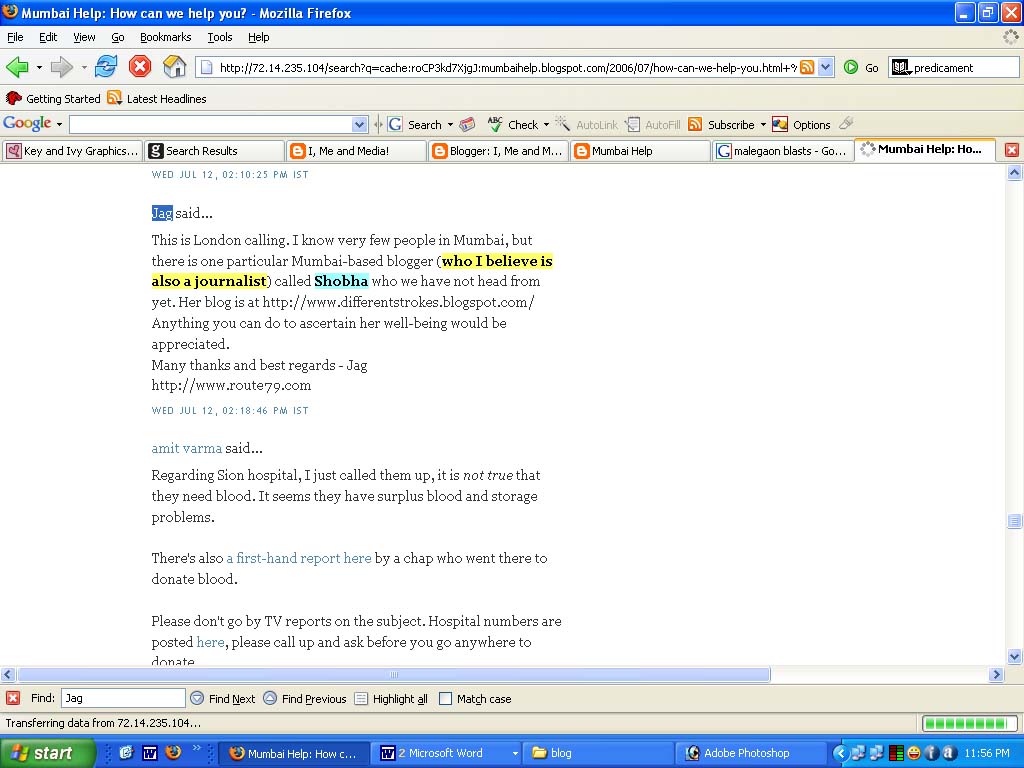
When I read it, I was completely puzzled. Some of the UK bloggers whom I know of are Jag, Chakra and Dubukku. I immediately went to the site to check who might have wanted to get in touch with me. I surfed through some of the comments and found out that it was jag who was worried about me. I found this...


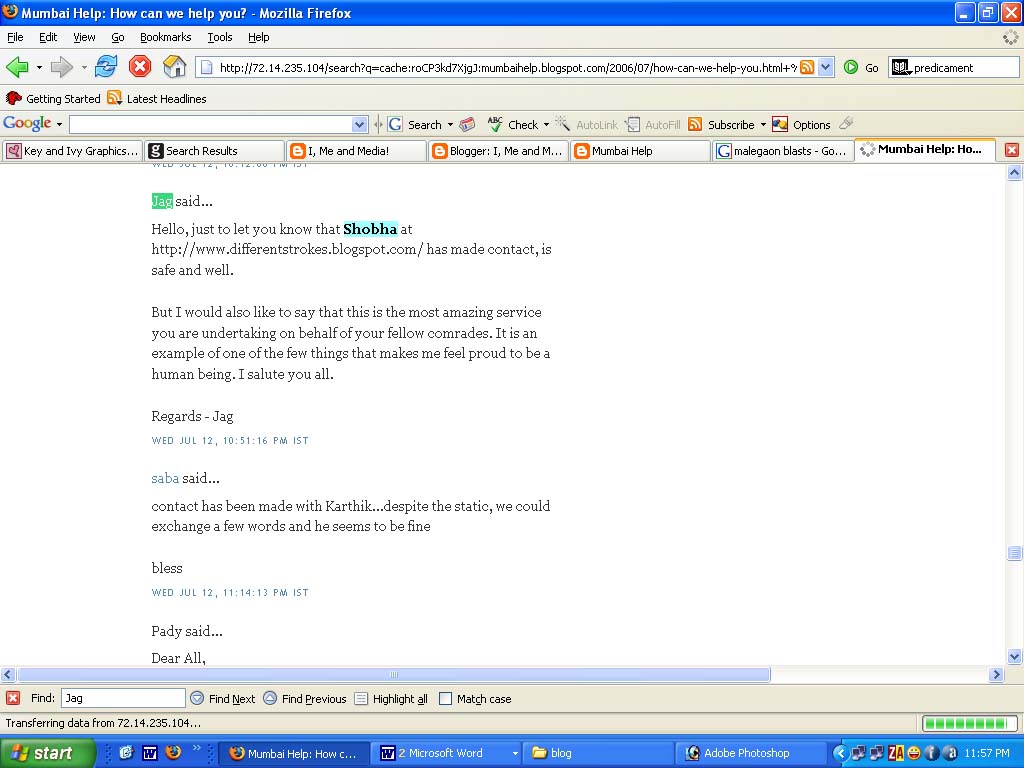
and this....


I remember Jag and Dubukku had left behind a comment on my blog inquiring if I am safe. I remember having responded in couple of days. However, I did not know that he had also made inquiries at the Mumbai help blog. {They have removed the comments on the blog wherein people have confirmed the whereabouts of their friends. However, I looked around for its cache and managed to grab a screenshot.} I would never have known that he had made inquiries had it not been for the stranger who left the above message.

To be frank,I am overwhelmed. I discovered this just a few days back. I did not know that there were people living miles away from where I live inquiring if I am safe. Though we have been around for just couple of years,my interaction with them is restricted to just comments on each other's blogs.Thanks Jag. Thanks Dubukku for making the effort. They needn't have done that, but they went ahead and did it nevertheless. It was really sweet of you guys to do that. You really made my day. I will never forget this gesture. I guess this is what Blogging has given me. So much goodwill, so much love and so many friends. Thank you.


P.S. While chatting with one of my colleagues, I wondered aloud about the exact motive of the blasts in Malegaon. He said, "Well if Lashkar E Taiba is caught involved as the popular perception goes, I guess they are trying to tell the world that they are secular terrorists, they kill people of all relegions." :|